


Forward
Spencer’s record unfolds like a conversation that didn’t know it was building toward meaning. Moving between memory and preservation, it traces a life shaped less by arrival than by accumulation: early experiments uploaded and semi-forgotten, faith worn like prescription lenses, necessary, imperfect, clarifying. There are (what some may call) detours here: six majors, eight kids, years of helping other people finish their work before starting one’s own, but no wasted time. Each track listens for what lasts: the music that slipped through strict walls, the record sold for someone else’s joy, the therapy that stays ongoing,and a legacy that doesn’t rush itself into permanence. This is not an album about becoming someone else. It’s about noticing who you’ve been long enough to let it stand.
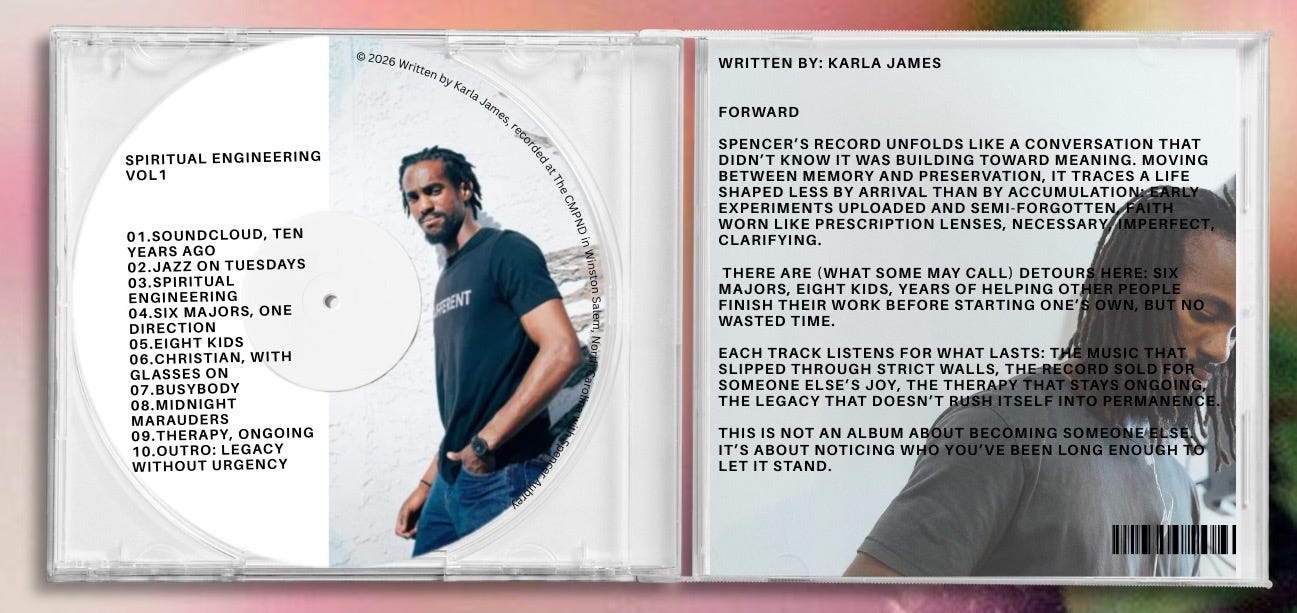
01.SoundCloud, Ten Years Ago
Do you have tracks that never leave the hard drive? They sit there quietly, waiting, not unfinished so much as patient. Spencer has some of those, beats uploaded to SoundCloud almost ten years ago, the kind you describe modestly, like old photos you don’t want to overexplain. They’re okay, he says. “They’re not, like, crazy.” But time does something strange to sound. A decade later, even a rough mix becomes evidence: proof that you were already listening closely, already arranging silence and intention.
Back then, for Spencer, making music wasn’t about audiences. It wasn’t about release schedules or streaming platforms. It was about learning how to sit with yourself long enough to finish a thought. A line of prose. Learning how to layer, how a bass line could hold a feeling… steady, while something else moved on top of it. The irony is that those early tracks were some of the only things he made purely for himself. Those tracks, beats were just enough to prove the idea could exist outside of his body. Everything since has been relational. Shared. Offered.
SoundCloud becomes less a platform and more a timestamp: ten years ago, before DJ residencies, before community ecosystems, before the word legacy starts circling quietly in the background of one’s mind. What he didn’t know yet was that solitude would become rare. That his creativity would be folded into other people’s needs. That ten years later, he would be circling the idea of his own record, not because he lacked discipline, but because he kept choosing to hold space instead. And we are all grateful.
02.Jazz on Tuesdays
There are nights where Spencer doesn’t lead anything. He just shows up. Jazz on Thursdays at Easy Tiger. Tuesdays at Wiseman. Sometimes he plays. Sometimes he listens. Jazz is generous like that. It lets you enter where you are. It doesn’t demand control.
These nights matter because they mirror how Spencer moves through life: adjacent, attentive, responsive. A Creative trying to understand the room itself- in a life filled with gigs, events, teaching moments, and community labor.
In between DJ gigs and sound work, between hosting poetry slams at the Bookhouse and turning community rooms into temporary sanctuaries, these interludes matter. They’re the breaths between movements. The proof that art doesn’t always need an outcome. Sometimes it just needs witnesses.
03.Spiritual Engineering
We ended up joking that Spencer should tell people he has a master’s in Spiritual Engineering. Half joke- half confession.
He started college trying to be a literal engineer. Six majors later, he landed in general studies, STEM on one side, literature on the other, before eventually earning an MA in poetry, which would sound like the opposite of engineering until you listen closely.
Poetry is architecture for emotion. DJing is physics. Community building is logistics. The through line isn’t confusion. It’s calibration. An instinct to understand ecosystems: emotional, communal, spiritual.
Spiritual engineering isn’t about fixing people. It’s about building bridges between spaces that would otherwise never meet. DJs do this without naming it. Poets do it by accident. I think Spencer does it because he knows what it means to be gifted and unsure of where to put it. He connects musicians to venues, people to each other, ideas to environments. He creates conditions where something meaningful might happen.
It’s not glamorous work. It’s infrastructural. And like most good infrastructure, you only notice it when it’s missing.
04.Six Majors, One Direction
Six majors sounds chaotic or looks like indecision until you realize they all pointed the same way: toward meaning-making.
Dance came first, church productions, jazz-influenced choreography, bodies learning theology before language arrived. Choir followed. Then writing. Music was always the root system, even when it wasn’t the visible tree. Direction doesn’t always look like focus. Sometimes it looks like exploration with integrity and his parents weren’t strict about careers. The freedom his parents gave him academically, try this, try that, became the blueprint for how he moves through creative life now. He explored widely, knowing some paths would dead-end, knowing others would loop back around later with maybe better timing.
Curiosity refusing to shut up.
05.8 Kids
At one point, there were eight kids in the house. Four biological siblings. Four foster siblings. High school. Middle school. Authority structures colliding. Too much emotion for square footage? Spencer doesn’t romanticize it. He names it plainly: “That shit was crazy.”
There are things he blocked out, not out of denial, but necessity. Survival demands selective memory. What remains can be visceral to a child: the intensity and the noise.
But something else grew there too: endurance. Work ethic. The ability to navigate differences without flattening it. Living with that many people teaches you how to read a room quickly and how to take responsibility before anyone asks.
Interlude: Listen to Spencer’s playlist titled “Spiritual Engineering” while you take in the rest of his story - including December-Artificial Christian in which he is a part of.
06.Christian, Without Glasses
Spencer still calls himself a Christian, but not the inherited kind. The examined kind.
For years, faith was defined for him. Over time, it became something he dismantled for himself, and rebuilt. He explored Buddhism, Taoism, and Islam through relationship. He read scripture with adult eyes until it said something new.
He talks about Christianity like a pair of glasses. Without them, the world blurs. With them, he sees shape and meaning, not certainty, but clarity. He doesn’t need Faith to be simple. He needs it to be honest. That lens shows up everywhere- in how he forgives, how he believes communities should function. Removing it, whether in music or writing, would mean misrepresenting how he actually sees the world.
07.Busy Body
Before meeting, I asked Spencer to think about his favorite albums. One from childhood and another in adulthood. Luther Vandross’ Busy Body was his childhood pick. It played in the background of an otherwise tightly controlled musical childhood. Christian Contemporary Music dominated the house, and the burnout became heavy. So when Luther showed up, it mattered.
Music outside the approved category wasn’t rebellion; it was oxygen.
Busy Body becomes a metaphor later, a reminder that curiosity, even when constrained, finds its way in. Spencer has always been paying attention to what moves people. He notices patterns. He watches systems. He listens between tracks.
08.Midnight Marauders
Enter A Tribe Called Quest, his adulthood pick, like contraband and stays like scripture.
Midnight Marauders wasn’t just an album; it was sonic education. It taught him that intellect and groove could coexist. Without writing a whole thesis, I will say, this wasn’t just an album. It was education. Rhythm with rigor, playfulness with precision. It shows that culture can be thoughtful without being heavy.
Spencer sold the record recently, generously, and immediately regretted it. That’s what we love about Spencer- he’d rather give up a piece of something he loves, for someone else to enjoy it also. The scratch on track 5 doesn’t matter. What matters is that the music taught him how to listen to people, to himself, to systems.
09.Therapy, Ongoing
Therapy isn’t a breakthrough moment here. It’s maintenance.
Spencer talks about forgiveness as the choice to stop punishing someone. Not reconciliation. Not proximity. Release. It’s a definition shaped by scripture, experience, and hard-earned boundaries.
He’s ended friendships. Learned to recognize when someone, himself included, is acting out of character. Growth, for him, looks like selectivity. How to apologize, in person, and be able to say “yeah, I was out of line.” How to leave without spectacle. Choosing sustainability.
Even DJing, the thing that pays the bills, has required renegotiation. As artists and creatives, we all come to a point where our art is turning into income, and that can nearly break our relationship with art itself. Weddings, bar gigs, and requests that maybe were stripping away his agency convinced him he was done. At one point, he was down to one last item to sell off- until the music called him back. What changes isn’t the work or the art, it’s the boundaries.
10.Outro: Legacy Without Urgency
Spencer is thinking about legacy now, softly.
He doesn’t need to be remembered loudly. He wants to leave something accurate. Poetry already does this for him, commissioned pieces, performances, moments that mark time. Music feels heavier, more involved, but also inevitable.
When he imagines his future sound, it’s house music infused with soul, gospel, R&B. Spiritual music without explanation. Something he could still play at ninety years old.
Legacy, for him, isn’t about output volume. It’s about resonance. Adding something honest to the canon of whatever this is, this city, this ecosystem, this life.
No urgency. Just intention.
The record is still being made.
Find Spencer at p.s. edekot
A Note for the Reader from the Writer
You don’t have to make what Spencer makes to recognize what he’s doing. You don’t need turntables, a mic, a chapbook, or a room full of people listening. What this “record” offers is permission to move at your own pace, in your own art, to honor the seasons where you are holding more than you are producing and to trust that attention itself is a form of creation. Spencer’s work reminds us that creativity can look like care and refusal. That the way you show up for others, the boundaries you learn to draw, the patience you practice with yourself, these are not detours from the work. They are the work. If you leave these pages feeling less rushed, more honest about where you are, or newly willing to listen, then something has already been made.