


“ “Drag Queen storytime” has finally attempted a debut in Davie County. Brought to us by one of the recent businesses to move in downtown.
One of the top rules of running a business, you listen to your customers feedback, you know your client base. This type of event is not wanted in our county. When downtown leadership allows businesses to move in to fill store fronts that don’t reflect the morality of the community these things are bound to occur. How do we stand in opposition to businesses we don’t agree with? Contact the owner and try to voice your concerns. When a resolution is not met, don’t spend your money and spread the word about not supporting the business. Bad word of mouth reviews are like wildfire in a small community.
Why the owner would jeopardize any of her business for this event is mind-blowing. This is not representative of our county. You have an opportunity to fix this or you can continue to divide. Finally, where are the church leaders in Davie County? How long will you stay silent on issues that do not glorify God within this community?”
The post circulated quickly on Facebook under a group titled “Parents for Kids Health”
It framed Regina as a threat before most of the county knew her name. It reduced her bakery to “one of the recent businesses.” It implied that morality had a zip code and she had crossed it.
Inside her building, she was testing cookie recipes for children who, as she would later say, “just like stories.”
Outside, the argument had already begun.
Regina did not arrive in Davie County to provoke it.
She arrived in North Carolina at a very young age. Grew up biracial in this mostly white, conservative town, raised in a mostly white family. “I have a lot of feelings about it,” she says, which is both an understatement and a boundary.
//
Her love of baking began in her grandmother’s kitchen. Her grandfather is a pastor, and church was constant, Sundays, choir meetings, fellowship halls humming after service. Her grandmother baked for all of it. Regina wanted to be wherever she was: measuring, stirring, watching butter soften under warm hands. Her grandparents showed love through food. Most of her memories of them are anchored in it, special occasions marked by something rising in the oven.
“For me, food has always been joy and community and comfort,” she says. “I always knew I wanted to be a part of that for other people.”
It all stems from her grandmother. “I wouldn’t do the things I do now if it weren’t for my time with her.”
//
She left for Charlotte to attend culinary school and lasted long enough to recognize what she did not want. “I like cooking because I like feeding people,” she says. “Hearing stories. Making it for people.” What she found instead was a culture mostly built around margins and scale. “The heart was kind of gone.”
So she stepped away.
She worked in restaurants, bakeries, breweries - learning by immersion rather than instruction. She helped build bakery programs from scratch. Wrote recipes. Ordered ingredients. Planned menus. Often the youngest in the kitchen. Sometimes the only woman. Frequently underestimated. She stayed long enough to know she could do it herself.
After leaving restaurant kitchens and working her way through Winston-Salem’s food scene, she spent nearly three years at the farmers market. A folding table. Tents. Early mornings. Regulars who came back week after week.
When she applied for the Heinz Black Kitchen Initiative grant, a national program through The LEE Initiative that invests in Black-owned food businesses , she did not apply with plans for a brick-and-mortar bakery. She applied to widen her stand at the farmers market. More equipment and more capacity.
She saw a baker she had long admired, Cheryl Day, speak about the grant online and thought, almost offhandedly, why not?
She received it.
The award validated what she already knew, that the work she was doing mattered.
Around that same time, she was driving through Mocksville with her now husband. Regina and her grandfather share a quiet affection for old roadside storefronts, former convenience stores, produce stands, and all-around buildings that have been something before and might be something again.
One caught her eye and she pulled over.
She called the landlord. “I can be there in five minutes,” he said. She signed the lease in October. By April, the lights were on.
Queer college students did homework there in the evenings. Fundraisers for abortion access and LGBTQ organizations happened openly. People lingered. She worked alone most days in ten-hour stretches, headphones on, flour in the air. Ownership brought freedom and isolation in equal measure.
Then she scheduled a drag story time. Cookies. Hot chocolate. A loved local performer, Anna Yacht, reading children’s books.
The reaction online was swift and disproportionate. Accusations. Threats. Calls to city council. The sheriff’s department parked across the street the day of the event because of the volume of hostility. Inside, one hundred and fifty people came.
Outside, a few dozen protested.
“The kids loved it,” Regina says. Anna Yacht, who had grown up in that same county, once closeted, stood in front of children as her full self.
What most of us didn’t know is that four days before the event, Regina received a call from her landlord. The lease would not be renewed over “creative differences.” The landlord had been harassed and the controversy, he implied, was too much.
Regina had not broken any rules. But she had disrupted something.
“If that’s what took me out,” she says, “I’m proud of that.”
The bakery closed about a month after the event. What followed was far from a retreat though.
Regina now runs a men’s shelter in Winston-Salem. Thirty men at a time. Cots. Pillows. Laundry. Meals cooked with the same care she once gave to pastries. Many of the men are ankle-monitored. Fresh out of prison. Fresh out of rehab. Many hold jobs and still cannot secure housing. Many carry mental health diagnoses that complicate every step toward stability.
“I feel safer with these guys than I would on the street,” she says. “They would stop a train for me.”
The work is intimate and tiring. She cries often and has watched men recognize her one evening and not the next. She has adjusted her own thinking about addiction and incarceration. “I used to think if you were in jail, you were just this terrible, awful person,” she admits. “And then I meet these guys. Some of the kindest, sweetest, nicest people.” Cooking their favorite meals when she can as a way of giving them something warm or something that says you are still seen.
She pushes back gently against the assumption that unhoused people want to be unhoused, urging local businesses to consider an exchange instead of exclusion. “They’d rather sweep your floors for a cheeseburger than get it for free,” she says. Dignity, to her, is reciprocal.
She once achieved the dream she had set for herself - owning a bakery at twenty-seven. It ended in controversy and applause and a lease termination. Regina will always call it beautiful anyway. Her goal now: “Be happier than I was the year before.”
What Regina will continue to speak about is food. Feeding people. Listening.
The Facebook post warned that she might divide the county and really, she just revealed it.
Writing without a paywall is important to me, but writing does take time. If you enjoyed this post, consider buying me a coffee! It would make my day <3
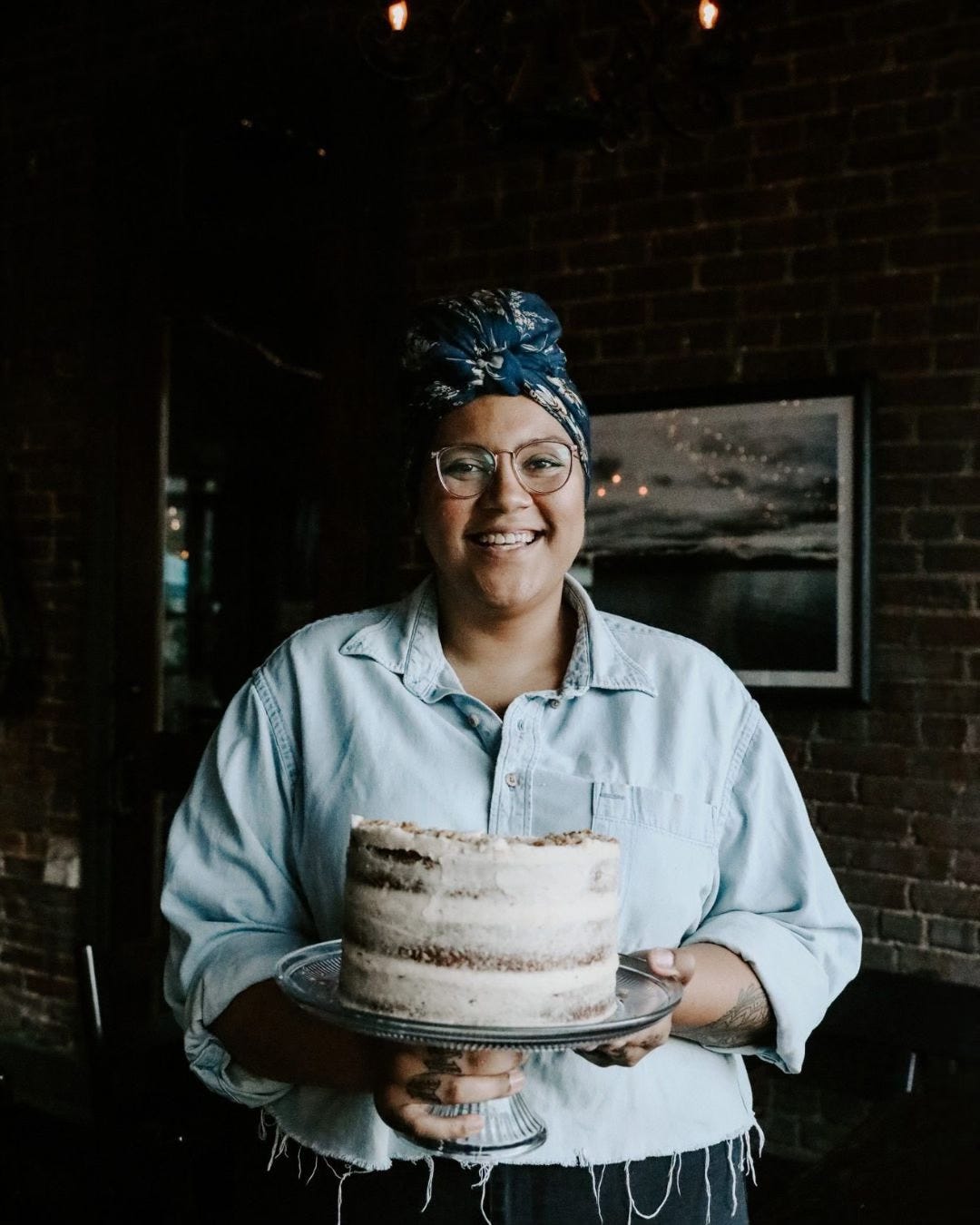
Photo by: Megan Moore of Merritt Media (NC)
I had no idea! Thank you for sharing this important story.